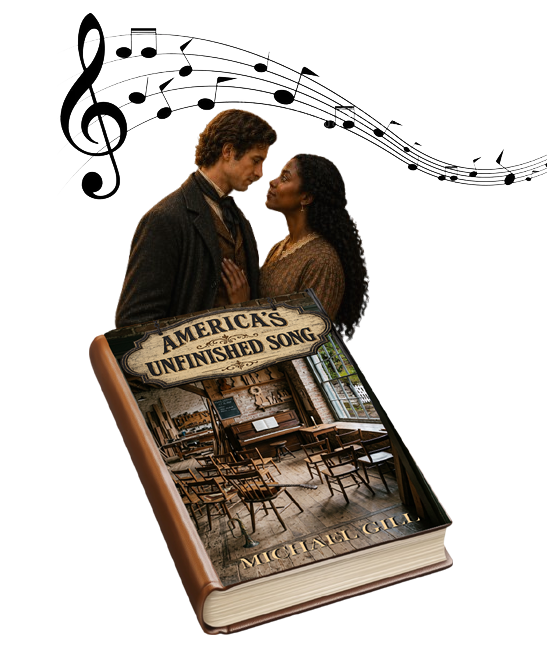
Part One · Two Families, One Story
Philadelphia
In the workshop on Market Street, a boy who can catch music by ear discovers his five-year-old sister at the piano, playing something no one taught her.
At the end of the block, beneath a weathered signboard and beside a wide alley smothered in fog, stood the Mackullman workshop, which smelled of sawdust and varnish and fresh-cut pine. Caleb had been sanding the leg of a rocking chair at the bench by the window when something in the parlor made him stop. It was the piano. Three notes, and then two more, and then a pause before the first three came again, only slightly changed—turned, the way a person turns a thing over in the hand to see it from the other side. He knew the pieces Nora was supposed to be practicing, and this was not one of them.
Around him the workshop went on as it always did. A saw rasped behind the partition, his father’s voice carried low and even through some negotiation with a customer, and from the street came the clatter of wheels over the stones. Caleb heard none of it. He set the sandpaper down and listened to the parlor, where the three notes came a fourth time, patient and deliberate, and then broke off.
“Nora?” he called.
The music stopped. For a moment there was only the silence of a child caught at something, and then one soft note, struck as if by accident, drifted back to him. He smiled and went to find her.
She was sitting on the piano bench with her feet nowhere near the floor, five years old and small enough that she had to lean forward to reach some of the keys. Her dark hair had been tied back that morning, though by now several strands had worked loose and hung about her face, and beside her on the bench lay a sheet of paper.
“What are you playing?”
“Nothing.”
“I heard you.”
“I was just trying it.”
“Trying what?”
Nora did not answer. She played the three notes again.
Caleb came closer.
“That sounds different.”
“I made it.”
He looked at her.
“You made it?”
She nodded.
“All of it?”
“Most of it.”
Caleb picked up the paper. Marks covered it—some like musical notes, others like circles and lines and shapes he could not understand. At the bottom Nora had drawn something that looked vaguely like a flower.
“What is this?”
“My song.”
“Does it have a name?”
“No.”
“Every song needs a name.”
“Why?”
“So you know what it is.”
She thought about that.
“It’s Caleb.”
He laughed.
“You named it Caleb?”
She nodded.
“Then I suppose it has a name.”